
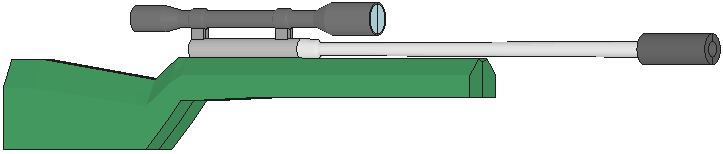
WHAT A TUNER DOES.... It is possible to "Tune" a rifle
barrel
so that where it is pointing at bullet exit time will compensate
for small
variations of muzzle velocity. In the "tuned" condition the slower
bullets are launched at a slightly higher angle than the faster
bullets. The
difference in launch angle can allow the slower bullets to hit the
target at the
same elevation as the faster bullets. That is the simple
explanation and now the
details.

FLIGHT PATH.... This chart shows the slower bullet actually
travels a
higher path than the faster bullet for them both to hit the same
50 yard zero.
It is clear that the flexible barrel's muzzle must launch the two
bullets of
different velocity at slightly different elevations for there to
be no vertical
spread at the 50 yard target. With only two place accuracy on
the drop
values, from 42 yards to 50 yards the round off shows the drop to
be the same.
With more accuracy, this would not be the case.
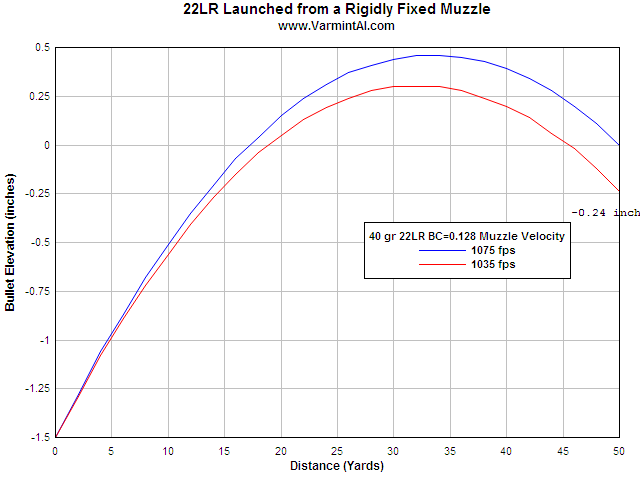
RIGIDLY FIX MUZZLE.... If the same two velocity shots were
fired from a
rigidly fixed muzzle with the exact same launch angle then there
would be a
vertical spread with the slower bullet striking low by
approximately 0.24
inches. This an approximate value because the ballistic program I
was using only
reports drop values with two place accuracy.
BUILT IN FLEXIBILITY.... The reverse taper barrel design
is more
flexible than a straight cylindrical barrel. The advantage of the
flexible
design is that it allows the barrel's muzzle to be pointing at
increasing
elevations for slower bullets. It is possible to tune a barrel for
Positive Compensation to minimize the vertical spread. See the
muzzle projection curves below.
FINALLY.... There is useful information in this FEA
analysis. But
there is no substitute for shooting bullets at a target. The FEA
analysis helps
one to understand what is happening when a 22LR is fired and how
the barrel
moves. The FEA analysis does not capture the urgency and stress of
a competition
match and is not meant to. Geoffrey Kolbe had performed an
experiment on Positive Compensation to minimize vertical spread.
Here is his article: Vertical
Dispersion with Velocity by Geoffrey Kolbe.
 YouTube
video: Ruger
Mini 14 barrel flex and muzzle blast, high speed camera Note
that the barrel
vibrates for many cycles after the bullet leaves. It is difficult to
see the
motion of the barrel while the bullet is traveling down the bore.
One can not
tell when ignition occurs which makes it difficult to see the early
time
motions.
YouTube
video: Ruger
Mini 14 barrel flex and muzzle blast, high speed camera Note
that the barrel
vibrates for many cycles after the bullet leaves. It is difficult to
see the
motion of the barrel while the bullet is traveling down the bore.
One can not
tell when ignition occurs which makes it difficult to see the early
time
motions.
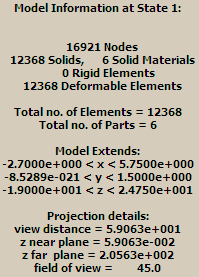
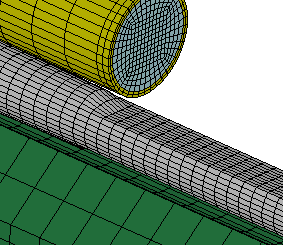
NODES AND ELEMENTS.... The solid elements are made of
6-sided
8-node bricks. The solid brick elements have a node at each corner
which define
the x, y, & z initial positions of each corner. These nodes
are not similar
and are not to be confused with the nodes present in vibrating
structures.
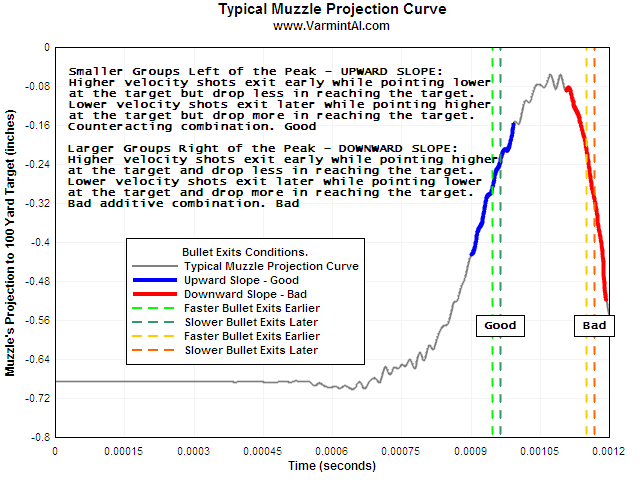
SUMMARY.... For the reader who doesn't want to wade through
all the
discussion here is a summary of what a tuner can do to correct for
small
variations in muzzle velocity from ammo with small variations in
muzzle
velocity. The Muzzle Projection Curve shows where the muzzle is
pointing at a
100 yard target while the rifle is being fired. The most important
aspect is the
curve is where the muzzle is pointing at the time the bullet exits
the muzzle.
Improving accuracy by compensating for small variations in muzzle velocity.
Smaller Groups Left of the Peak - UPWARD
SLOPE:
Higher velocity shots exit early while pointing lower at the
target but drop
less in reaching the target.
Lower velocity shots exit later while pointing higher at the
target but drop
more in reaching the target.
Counteracting combination. Less vertical spread. Good.
Larger Groups Right of the Peak - DOWNWARD
SLOPE:
Higher velocity shots exit early while pointing higher at the
target and drop
less in reaching the target.
Lower velocity shots exit later while pointing lower at the target
and drop more
in reaching the target.
Bad additive combination. More vertical spread. Bad.
The additional mass of a Muzzle Tuner slows down the muzzle
movements and allows
the bullet exit before the peak of the muzzle projection curve
during the upward
slope without resorting to high pressure loads.
ESTEN'S 22LR RIFLE.... Esten's barrel that is modeled is on a Myers Built 10.5# Rimfire Benchrest Rifle. It has a 24.75" Benchmark 2 Groove, Reverse Taper Barrel like currently holds the World Record. It has a Harrell tuner which clamps on to the end 1" of the barrel. The weights screw in the end and are stackable and available in different weights. The Reverse taper barrel has a short 1" long Breach Cylinder of 1.1" Dia. then radius down to .750" From there it tapers UP in dia. to .915" and has a .915 cylinder for the last 2" at the muzzle which is where the tuner clamps on. The details of the tuner and weight locations were not available so a homogeneous tuner mass of same external dimensions was modeled and the density was scaled to give the correct weight. The reverse taper is effective because it ALLOWS movement.
Table 1: Vertical Spread for 22LR Barrel Configurations with/without A Tuner
| Barrel Contour with 24.75" Length | Muzzle Velocity (fsp) |
Muzzle Projection to 50 Yd Target (in) |
Muzzle's Vertical Velocity (in/sec) |
Point of Impact at 50 Yd Target (in) |
Vertical Spread (in) |
| Straight 0.8" Dia | 1035 | -0.02145 | 1.6118 | -4.1236 | 0.1108 |
| 1075 | -0.06311 | 1.5214 | -4.0128 | ||
| Straight 1.0" Dia | 1035 | -0.7222 | 0.4774 | -4.9956 | 0.1974 |
| 1075 | -0.7373 | 0.7595 | -4.7982 | ||
| Straight Taper 1-1/4 to 1" |
1035 | -0.5196 | 0.3696 | -4.8092 | 0.1926 |
| 1075 | -0.5230 | 0.5353 | -4.6166 | ||
| Esten Reverse Taper No Tuner |
1035 | -1.3183 | 1.3303 | -5.4629 | 0.0910 |
| 1075 | -1.3869 | 1.2790 | -5.3720 | ||
| Esten Reverse Taper 4.9 oz Tuner |
1035 | -1.7178 | 0.6895 | -5.9592 | 0.1218 |
| 1075 | -1.7434 | 0.5327 | -5.8374 | ||
| Esten Reverse Taper 8.6 oz Tuner |
1035 | -1.9640 | 0.5265 | -6.2315 | 0.1554 |
| 1075 | -1.9682 | 0.4377 | -6.0761 | ||
| Esten Reverse Taper 16.0 oz Tuner |
1035 | -2.4183 | 0.4378 | -6.6977 | 0.1832 |
| 1075 | -2.4022 | 0.4076 | -6.5145 | ||
| Rigidly Fixed Muzzle | 1035 | 0.0 | 0.0 | -4.3455 | 0.1737 |
| 1075 | 0.0 | 0.0 | -4.1718 |
22LR AMMO.... In 22LR benchrest, the ammo is fixed and can
not be
tuned to the barrel. But the barrel can be tuned to the ammo. The
only function
of tuning is to compensate for small variations in muzzle velocity
from shot to
shot. The 1035 to 1075 fps range is an extreme spread but gives an
indication of
what improvements can be made to compensate for velocity
variations. The
calculations have been performed at these two velocities to
determine if
variation if muzzle can be compensated for and reduce the vertical
spread at the
50 yard target.
If somehow, the muzzle were rigidly fixed in space and two rounds
were fired,
one with a velocity of 1035 fps and the other with 1075 fps there
would be a
0.1737 inch vertical spread because of the different amount of
drop. See the
bottom row of Table 1. A tuner can cause the slower bullet to be
launched to a
higher point and the faster bullet at a lower point. This can't be
done with a
rigidly fixed muzzle. I believe that a rigidly fixed muzzle is
impossible with
any reasonable rifle configuration.
For each calculated shot's Point of Impact (POI), the
following was
calculated:
1. Muzzle's projection to the 50 Yd Target
2. Muzzle's vertical velocity transmitted to the bullet at exit
3. Time of Flight (TOF)
4. Drop during the flight to the target (ballistics - 4.345 in
for 1035 fps and
4.172 in for 1075 fps)
5. Bullet's vertical displacement from 2. during the TOF
6. Pressure curve scaled for the correct Muzzle Velocity
7. Bullet exit time
8. Gravity of 386 in/sec^2
Note: Not only is the muzzle exit angle changing in time,
but the muzzle
is also moving in the vertical direction while the bullet is
traveling down the
barrel. When the bullet exits the muzzle, the bullet will have the
same vertical
velocity as the muzzle. The bullet's vertical velocity during the
TOF will also
effect the vertical impact point at the target.
The Muzzle Projection Curves include the vertical displacement of the muzzle and the angle of exit, both projected to the 50 yard target. The low Point of Impact (POI) numbers result from the barrel pointing at zero in zero gravity. When gravity is applied, the muzzle sags and its projection points lower on the target. The amount of projected sag can be seen at zero time on the charts. There are times when the muzzle's vertical projection is zero at the top or bottom of each cycle, but the exit angle is not necessarily zero at the same time.
The Time of Flight (TOF) and the bullet's vertical velocity charts were generated so the additional bullet drop from this contribution could be calculated. The difference in the vertical spread from TOF and the muzzle's vertical velocity is small compared to where the muzzle is pointing but is included in the values listed in Table 1.
There was a lot of work involved in performing these calculations. My motivation is to try to gain an understanding of what is happening when a rifle is fired. The FEA allows one to inspect the very smallest of detail of the event calculated. I am sharing these results in a hope that others might find some useful information in shooting smaller groups.
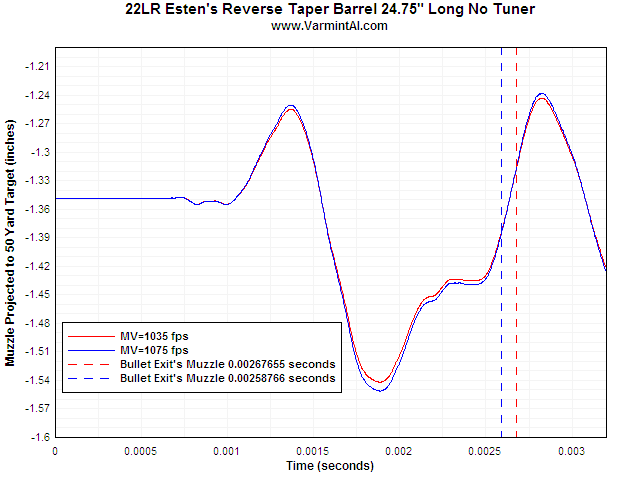

REVERSE TAPER BARREL.... The vertical spread for the
Reverse Taper barrel
and No tuner has a steep rising slope at the time of bullet exit.
The vertical
spread is 0.0910 inches for the two different loads (1035
and 1075 fps).
This was the smallest vertical spread of the barrel configurations
calculated so
far. The movie clip shows the deformations of Esten's
Reverse Taper barrel
with a 1075 fps muzzle velocity and no tuner. The last frame of
the animation
coincides with the bullet exiting the muzzle. The muzzle is not
stationary and
points to different locations on a 50 yard target as shown by the
chart and
movie clip. The deformations are amplified by 2000X. The barrel
axis points at
zero on the 50 yard target. Gravity is applied and the stock
deforms as well as
the barrel sage. That is why the muzzle starts out pointing
approximately 1.35
inches below zero. The muzzle projection includes the vertical
motion of the
muzzle and the exit angle projected to the 50 yard target. It is
as if there
were a tiny laser taped to the muzzle and it traces the curves on
the
target.
Smaller Groups Left of the Peak (Positive or Upward Slope):
Higher velocity shots exit early (blue curve)
while
pointing lower at the target but drop less in reaching the target.
Lower velocity shots exit later (red curve)
while
pointing higher at the target but drop more in reaching the
target.
Counteracting combination.
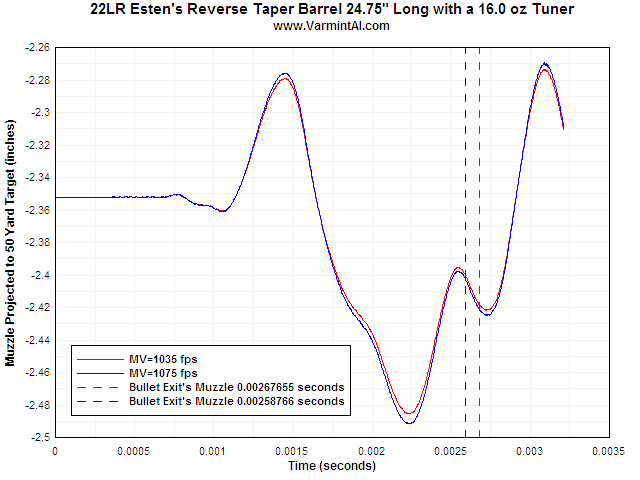
TUNER OF 16.0 OZ.... There can be too much of a good thing.
The vertical
spread with the reverse taper barrel and a 16.0 oz tuner is 0.1832
inches.
This was the largest vertical spread of the barrel configurations
calculated.
The bullet exit time is centered on a negative or downward slope
of the Muzzle
Projection Curve. The movie clip shows the deformations of Esten's
Reverse Taper
barrel with a 1075 fps muzzle velocity and a 16.0 oz tuner. The
last frame of
the animation coincides with the bullet exiting the muzzle. The
muzzle is not
stationary and points to different locations on a 50 yard target.
The
deformations are amplified by 2000X. The muzzle and 16 oz tuner
are not
stationary and points to different locations on a 50 yard target
as shown by the
chart and movie clip. The deformations are amplified by 2000X.
Larger Groups Right of the Peak (Negative or Downward Slope):
Higher velocity shots exit early (blue curve)
while
pointing higher at the target and drop less in reaching the
target.
Lower velocity shots exit later (red curve)
while
pointing lower at the target and drop more in reaching the target.
Bad additive combination.
Two-Flats Barrel Contour
with Vertical
Flexibility and Greater Horizontal Stiffness
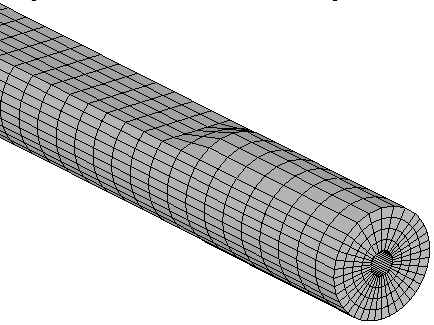
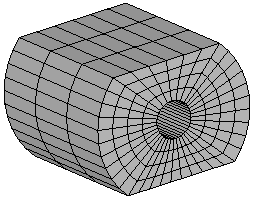
THE TWO-FLATS CONTOUR.... The barrel in front of the action
is 1.25"
in diameter and tapers down to 1.1" in diameter at 4" from the
action.
From there, the barrel diameter is 1" and the distance between the
flats is
0.643". The muzzle is 1" diameter for 2 inches so a tuner could be
used. It is 24.75" long. The flats start at 4.5" and extend to
22.25". At each end of the flats, the transition is 0.5" in
length.
This contour allows for more vertical flexibility in the vertical
direction than
a 1" full diameter barrel. But it has nearly the same stiffness in
the
horizontal direction as a 1" diameter barrel.
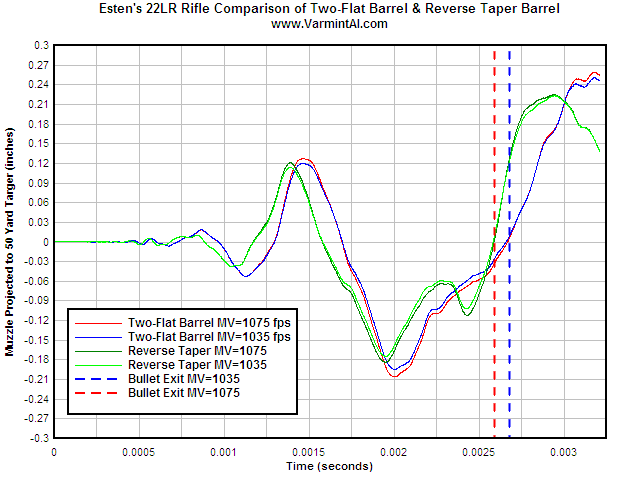
WIDER RISING PROJECTION WINDOW.... The Muzzle Projection
curve shows a
wider time period that the muzzle projection is rising that with
the Reverse
Taper barrel contour. It appears that it would be easier to fine
tune if a light
weight tuner were used on the muzzle. The sag due to gravity was
in the
calculations, but subtracted out for the chart so the curves can
more easily be
compared. There is less muzzle projection sag at the 50 yard
target with the
Two-Flats barrel than the Reverse Taper barrel. The calculations
included
gravity of 386 in/sec^2.

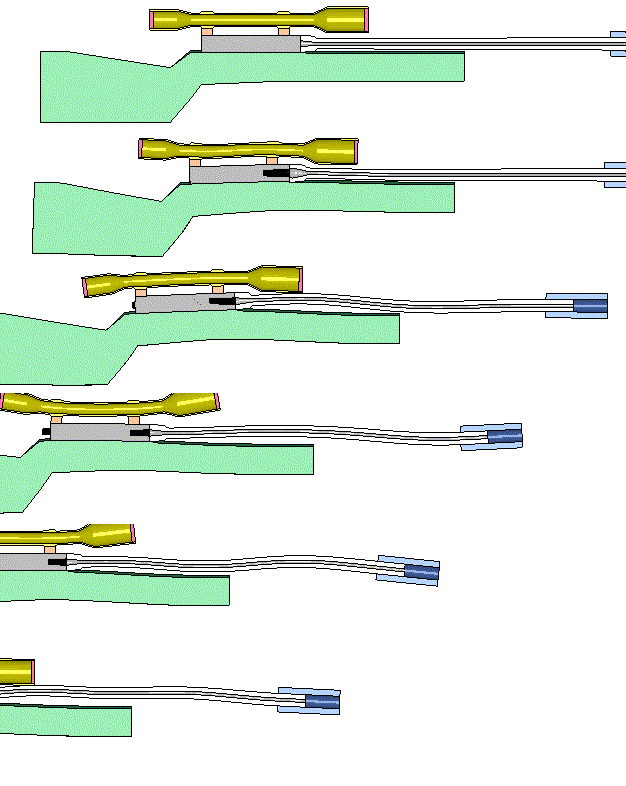
TWO-FLATS MOVIE.... Here is the movie clip of the
calculated motion for
the 1075 muzzle velocity round. The last frame occurs at bullet
exit time. The
displacements are amplified by 1000X. The stock contacts the
simulated sandbag
rests with zero friction in the calculation. The rests are fixed
in space.
Table 2: Rifle, Barrel, and Tuner weights
| Barrel Contour with 24.75" Length | Tuner Weight (oz) |
Barrel Weight (lb) |
Rifle Total Weight (lb) |
| Straight 0.8" Dia |
0.0 | 3.338 | 9.173 |
| Straight 1" Dia |
0.0 | 5.184 | 11.027 |
| Straight Taper 1-1/4 to 1" |
0.0 | 6.547 | 12.390 |
| Esten Reverse Taper No Tuner |
0.0 | 3.601 | 9.444 |
| Esten Reverse Taper 4.9 oz Tuner |
4.9 | 3.601 | 9.750 |
| Esten Reverse Taper 8.6 oz Tuner |
8.6 | 3.601 | 9.982 |
| Esten Reverse Taper 16.0 oz Tuner |
16.0 | 3.601 | 10.444 |
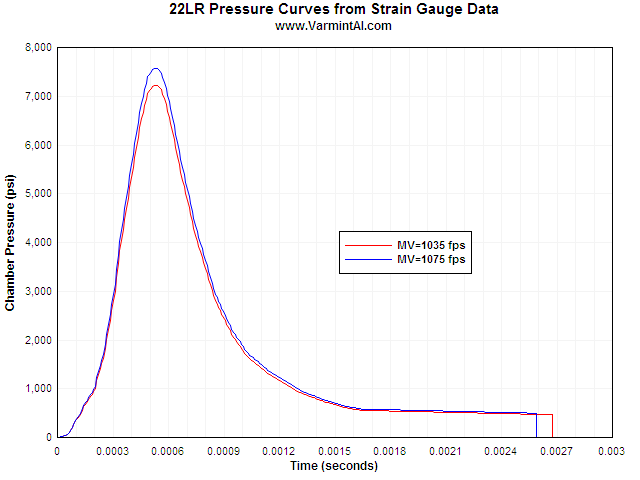
PRESSURE CURVES.... The chamber pressure curves were
generated from
strain gauge data. The data was scaled for the pressure amplitude
to generate
the given muzzle velocities for a 40 gr 0.224 caliber bullet in a
24.75 inch
barrel. The assumption for these calculations are that higher
velocity bullets
will exit earlier than lower velocity bullets. For some markedly
different
pressure curves with early high pressures that drop off to a very
low value
later, lower velocity bullets could exit earlier that higher
velocity bullets
but this is highly unlikely with a single lot of ammo.
COMPARISON CHARTS.... These charts are for comparing the Muzzle Projection Curves and the Muzzle's Vertical Velocity for each barrel configuration. All charts are at the same scale except for the 0.8" diameter barrel where the scale had to be increased to not clip the curves. The calculated vertical spread is listed after each set of charts. The sag due to gravity is removed from the Muzzle Projection Curves. This would be the case as if the rifle were sighted in at 50 yards zero for each barrel and muzzle tuner configuration.
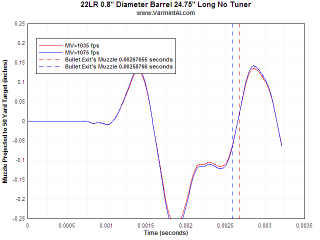
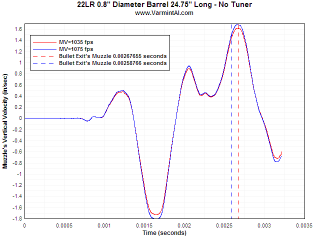 spread= 0.1108 inches
Note: The scale is increased for only these two charts.
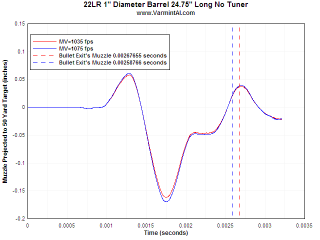
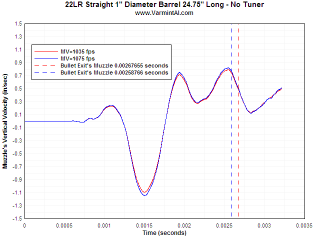 spread = 0.1974 inches
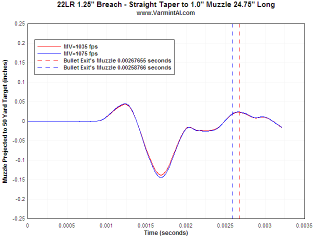 0.1926 inches
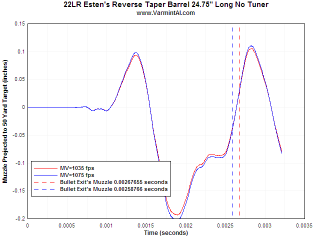
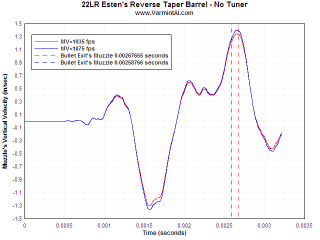 0.0910 inches
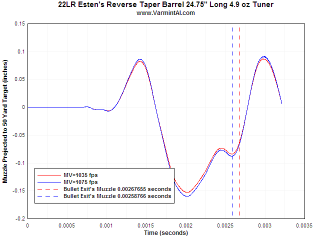
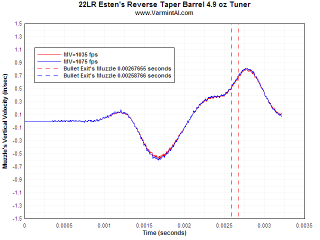 0.1218 inches
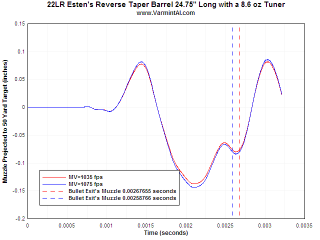
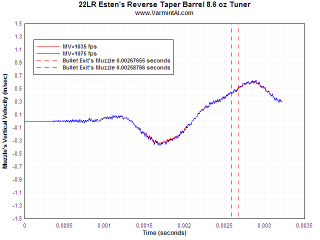 0.1554 inches
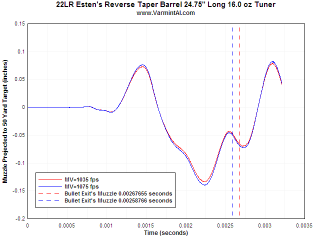
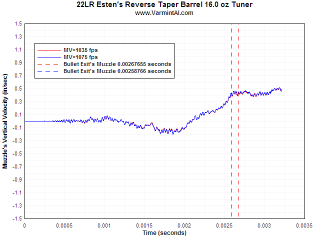 0.1832 inches

TUNING & DISTANCE.... Here is a chart that shows the
100 yard
trajectory of a 22LR 40 gr bullets with a BC of 0.128 and an
average muzzle
velocity of 1050 fps. It is assumed that the actual velocity
varies from 1040 to
1060 fps with the vertical tuned out. The first case (bottom
curves) is where
the vertical is tuned out at 50 yards. In this case the vertical
at 100 yards is
7.79-7.46 or 0.33”. The rifle is not in tune for 100 yards.
In the second case the vertical is tuned out at 100 yards. But in
this case
the vertical at 50 yards is 3.89-3.73 or 0.16”.
Anyone can calculate this for their rifle & ammo using free
ballistic
software. For small variations is muzzle velocity a 22LR rifle in
tune at 50
yards is NOT in tune at 100 yards.
LAUNCH ANGLE & DROP.... For the 1040 fps and 1060 fps bullets to strike at the same elevation at the 100 yard target, the launch angle for the 1040 fps bullet has to be elevated 0.2218 degrees above that of the 1060 fps bullet. If the muzzle were somehow fixed in space so that both bullets were launched at exactly the same angle, then the 1040 fps bullet would strike the 100 yard target 0.40" lower than the 1060 fps bullet. It is not rocket science that the slower bullet will drop more in traveling to the target.
Good Hunting... from Varmint Al
For the serious reader: How
to Check
Another Engineer's Calculation.
Last Updated:
07/18/2015
End of Page