
Tribute to My Dad
On Father's Day June 20, 2004
Tribute to My Dad
On Father's Day June 20, 2004
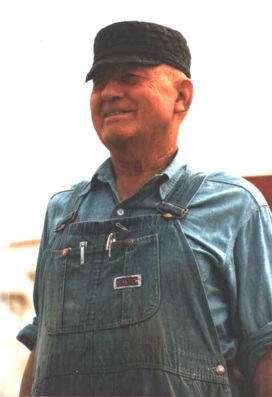
Alfred Harral Jr. 7/9/1908 - 11/26/2005
Picture taken in 1970
Pop in his own words recorded 1977
HAPPY 95th BIRTHDAY Pop.... Today, 7/9/2004 is Pop's Birthday. Pop, thanks for all you have done to make a better world and for all you have done to give me a good life.
POP IS A WELDER.... Pop learned how to weld in about 1938. He had a small welding shop in Oildale, CA for a couple of years. During the WWII years he was classified as "Essential" and worked in the oil fields welding pipe lines used to supply oil for the war effort. During this period everything was rationed and Pop learned that if you needed something it was best to build it your self. Pop became an artist with an acetylene torch and an arc welding machine. The pictures on this page of the hardware were taken in 2002 and all of the hardware is still there in Bakersfield, CA.
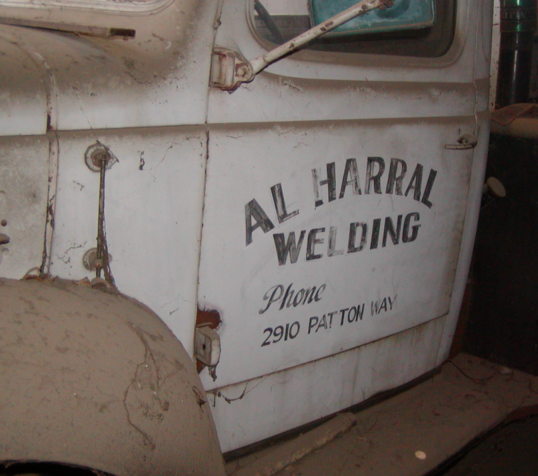
POP'S 4WD WELDING TRUCK.... After WWII, Pop bought an surplus military
4WD truck and converted it into his welding truck. It could go almost anywhere.
When school was out, he would often take me out on jobs in the oil fields with
him. He had a big two-trumpet air horn on top and on the way home, he would toot
it about a block away and we would know he was coming home. I still have dreams
about him letting me drive the truck and letting me use the 4WD.
POP LET ME USE THE LATHE.... I was about 10 years old when I started working on Pop's 10" Atlas lathe* when he was at work. I had watched everything Pop did on the lathe from the very first day he got it. My first project was a "bean shooter" which was a piece of mild steel about 4" long with a ¼" hole through it and fancy shapes on the outside. Each time I used the lathe, I tried to put everything back exactly like it was before I started, but Pop found out. He didn't even get mad, but just told me to be careful and gave me some instructions. I was in kid heaven. Then I made a tiny ball peen hammer with a round hole for the handle and found out why the holes in a hammer head are elliptical. The hammer head would twist on the handle when I tried to use it. I spent hours grinding a knife blade out of a piece of hot rolled bar stock. I had it all finished and showed it to Pop and he said it was no good. Pop was right, I couldn't sharpen it. That is when I learned there is a difference between iron and steel.
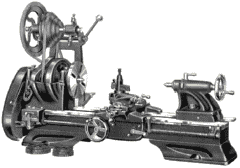
*Click on the Atlas 10" Lathe to see a full sized picture. The original 1936 model with integral "Overhead" countershaft drive. No power cross feed was fitted to these early machines. This picture brings back old memories.
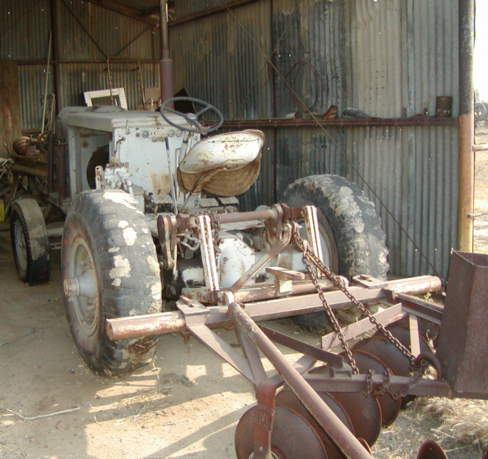
NEEDED A TRACTOR.... We had 5 acres and Pop needed a tractor,
so we made one. It had a '39 Plymouth 6 cylinder L-head engine, a Dodge truck
transmission, a Studebaker front axle, 6" heavy wall pipe frame and the
rear end was out of a White truck. Pop got two tires about 5 feet in diameter
from a motor grader for the rear wheels (one had a bald spot where part of the
tread was ripped off). Well, when it was all put together, we fired it up and it
would go about 15 MPH in first and 40 MPH in second gear (making the whole
tractor bounce from the flat spot on one tire) and you couldn't begin to get it
into third or fourth gear.
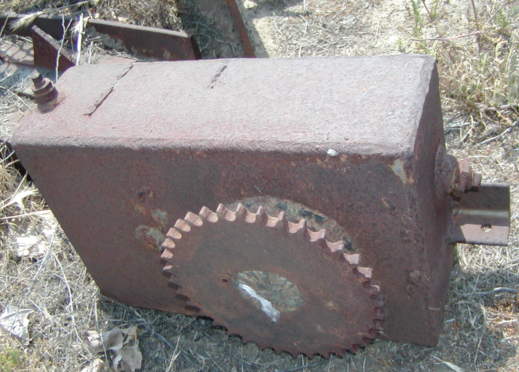
GEAR REDUCTION BOX.... Not to be discouraged, Pop got some big gears and
we built a gear reduction box between the transmission and the rear end. I did
the machine work on the 10" Atlas lathe, making the hubs that were welded
into the box to hold the ball bearings and seals. When it came time to put a
cover on the gear box, Pop just welded the cover on. It had half inch thick end
plates, a fill plug in the top (right side of the picture) and a drain hole in
the bottom and welded on cover and it was strong. It didn't leak and you could
hoist the tractor in the air by the transmission if you wanted. It was
positioned just right for the foot rest while driving the tractor.
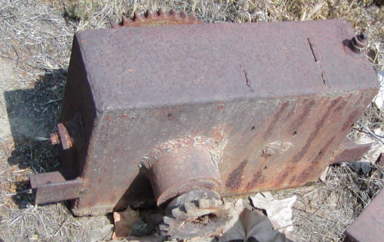
WE DISCOVERED MOLY GEAR OIL.... With the new gear box, the tractor would
go so slow in first gear that you had to almost reach out and feel the top of
the tires to see if it was moving. But it was just right for plowing in 3rd gear
with plenty of pulling power. When we built the gear box, we meshed the gears a
tad too close, center-to-center and it made a lot of noise and after about 15
minutes of plowing, it got so hot, you couldn't put your feet on it. That is
when I learned about molybdenum disulfide as a lubricant. Pop got some used Moly
transmission oil and put it in the gear box and what a change!. The noise was
greatly reduced and the gear box would keep your feet comfortably warm.
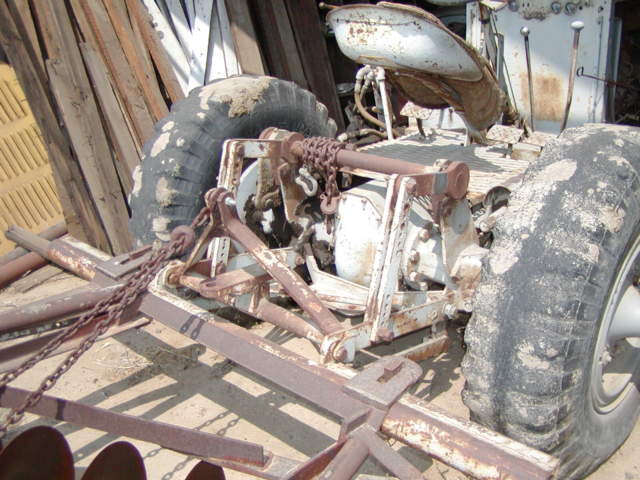
HOME MADE LIFTING DRAWBAR.... When I went off to college, Pop made this
lifting drawbar that was hydraulic powered.
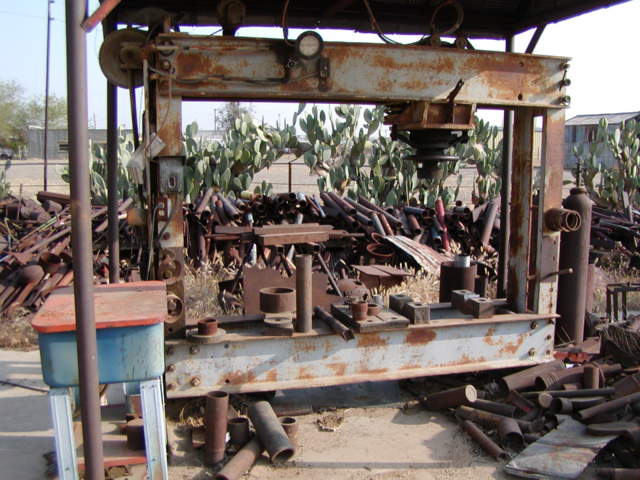
100 TON PRESS.... Pop wanted to build a 100 ton hydraulic
press. I did all the machine work making the 6" ID cylinder (composed of a
6" pump liner surrounded by an 8" pump liner with a poured in place
lead liner). There were two 12" I-Beams top and bottom with a 6' span. The
vertical columns were 2x5" solid bars.
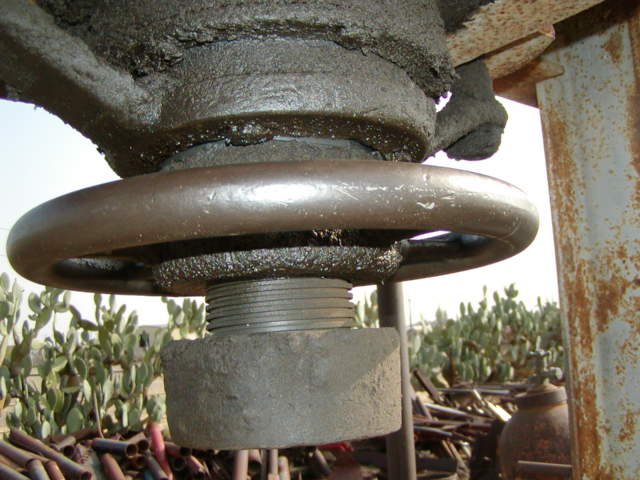
DOUBLE PITCH SQUARE THREADS.... I machined the ram out of a 4"
diameter shaft, and nut with double pitch square threads. It was tricky to cut
the threads. Pop welded on a large hand wheel from an old gate valve to advance
the ram shaft. There are two large coil springs to return the ram to the up
position after the pressure is relieved.
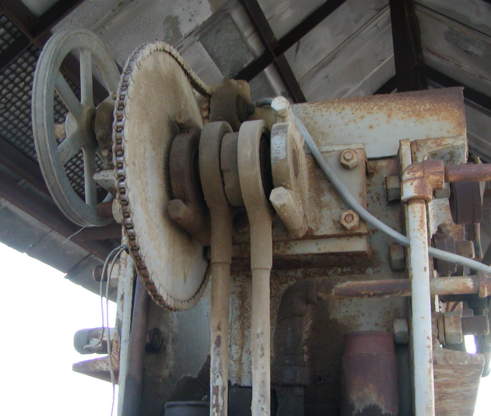
A TWO THROW CRANK SHAFT.... The crankshaft for the 2 cylinder hydraulic
pump had about a 3/4" stroke. The crankshaft had large diameter throws so
that sealed ball bearings could used. The press is still in use today, but the
old two cylinder pump is normally too slow and has been bypassed with a much
faster positive displacement rotary hydraulic pump. Pop said that when high
forces are required they have to resort back to the old two cylinder pump to get
the required high pressure.
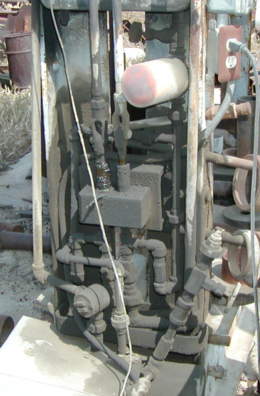
THE TWO CYLINDER PUMP.... I also made a two cylinder hydraulic pump out
of a piece of 3" square truck front axle. The piston diameters were about
1/2" so there was quite a mechanical advantage and very high pressures
could be obtained. When we were just finishing building the press a guy from one
of the trucking companies brought us a large front axle from a truck to
straighten. It really looked like an impossible job. Pop moved the ram to one
side of the press so as not to bend the I-Beams and, with the two cylinder pump
chugging away, it straightened that bent axle like it was made of soft lead. Pop
sure was proud of our new tool.
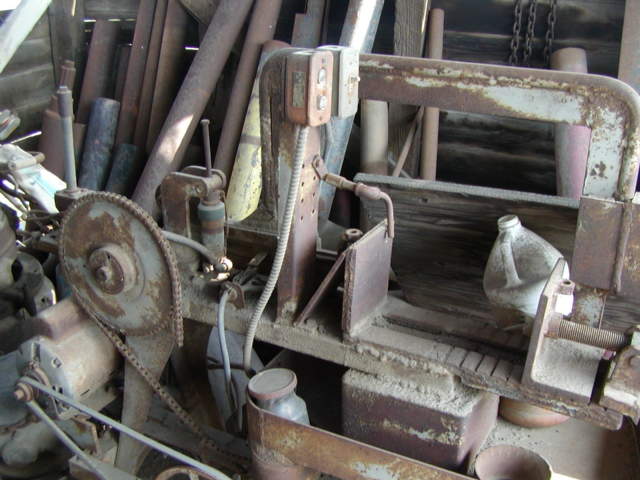
A POWER HACKSAW WITH A HISTORY.... Pop wanted a power hacksaw. He saw one
in the classified ads in the paper and bought it for about $20. I think it took
16" blades. Well, it wasn't very long before we found out that the hacksaw
was just too small. The first improvement was to make a larger frame. Pop made
it from sucker rod bent to shape with 1/4" plate welded inside for
stiffness. Now the frame was large enough and we could use longer blades, but
the vise wasn't large enough to hold large sized rounds. So the next improvement
was to make a larger vise with quick adjusting notches so one only had to crank
no more than 3/4" or so for any size. Pop welded the new vise onto the old
frame. Next the blades were wearing out too fast so Pop added a coolant flow on
the blade. The blades were still wearing out too fast. They were dragging on the
work on the back stroke.
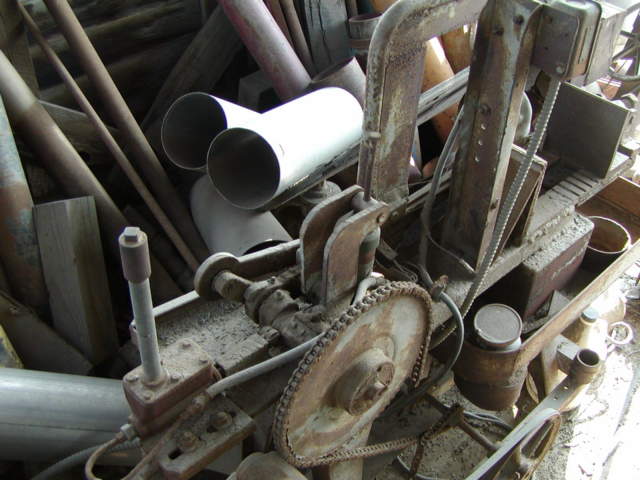
HYDRAULIC BRAKE SYSTEM TO THE RESCUE.... Pop took the master cylinder and
one wheel cylinder out of an old car and used it to lift the saw blade off the
work on the back stroke. I made a cam lobe that pushed the master cylinder
plunger on each back stroke and the wheel cylinder lifted the blade. This really
worked very well. Now the saw required so much force with the big long blade,
that it broke the cast iron connecting rod. Pop cut a new connecting rod out of
1/2" plate and I machined the ends to take ball bearings. Finally, we made
a jack shaft to reduce the load on the motor and the final drive had to be a
chain because a belt drive would slip. By the time we were done, we had a
new large power hacksaw that only used the original stand to support all the new
and improved features.
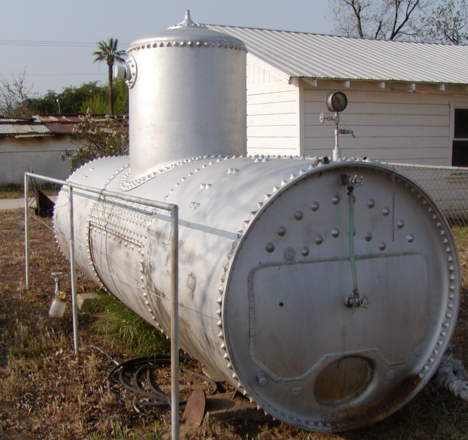
VERY STRONG DOMESTIC WATER SUPPLY.... We lived out in the country on 5
acres and had our own water well. The little 50 gallon water tank just wasn't
enough for Pop. They used boilers to heat the oil from our oil well to make it
flow better when it was time to transfer it to the refinery. Remember, this was
just outside of Bakersfield and when Pop bought the place, it had a producing
oil well. There was a spare boiler that Pop got for a song so he decided that it
would make a very good and strong domestic water tank. Pop cut the fire box
off the far end with a cutting torch. There were about 30 flue pipes that
went from end to end that passed the hot gas from the fire box. He cut the end
plates out that included the flue pipes and welded in 3/4" hot rolled
plates in each end. You can see the end plate shaped like the letter
"B".
BOILER SCALE REMOVAL.... Before Pop welded in the end plates, he told me to chip out all of the boiler scale so the water would taste better. It was a calcium- like rock hard deposit about a 1/4" thick all over the inside of the boiler, including the dome. Pop gave me a chipping hammer and started me to work cleaning out the boiler scale. After about an hour of chipping I had only cleared a small area of boiler scale down to the bare steel.
SLIDE RULE TO THE RESCUE.... I had just learned in school how to multiply and divide with an old cheap slide rule. I took a break from the chipping hammer and got out a tape measure, the slide rule, some paper, and calculated the area of the inside of the boiler. The area was Pi*Dia*Length for the cylinder and Pi*Dia^2/4 for the end plates minus the almost square cutout areas. Then I took the chipping hammer and marked off one square inch and timed how long it took me to chip it clean. I think it took about 3 minutes. When I multiplied out the time it would take me to chip the whole boiler clean, it was something like 3.5 years. I had to go back to school in the fall. I went and got Pop and marked off another square inch of boiler surface and chipped it clean while he was watching and he was timing me. Then I showed him my numbers and told him it would take 3.5 years to do the job. He just said, "OK I'll hire a sand blaster to clean out the boiler." At the time I wasn't sure whether he was mad at me for ducking the job or proud of me for being able to calculate how long it would take. Besides, he had a cable fence around 4 of the 5 acres for me to paint anyhow.
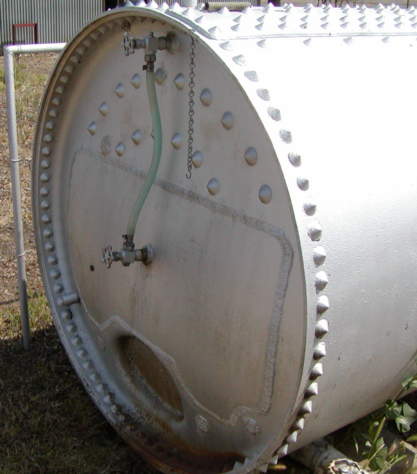
ALMOST A RUPTURE.... After Pop welded the end plates on the boiler we
tested it to see if their were any leaks. Pop had a big fire pump that would put
out a couple hundred psi of pressure. We hooked up the pump to the boiler and
started filling it with water. The dome makes a good air cushion for the water
tank and soon the pressure was starting to get up there. I don't remember how
high it was, but the 3/4" end plates started to bulge out! Pop immediately
hit the switch on the engine and stopped the pump. Pop looked scared and said,
"Good enough. It doesn't leak" You can still see the bulged end
plates. They are plenty strong for a domestic water system, but they weren't
good enough for the fire pump pressures. We almost had a rupture. The flue pipes
supported the end plates from bulging out in the original boiler configuration.
The flat end plates were way over stressed.
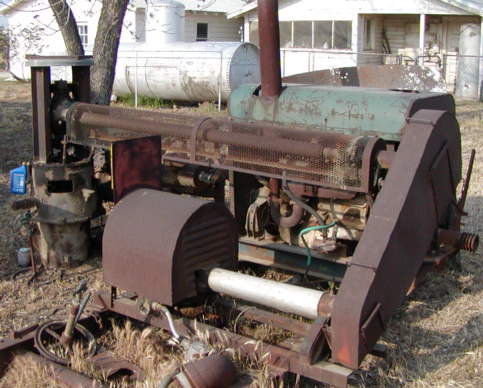
THE HOME MADE WATER PUMP.... For years, we had free natural gas from the
oil well. Normally they would have to flair it off and burn it, but Pop made a
separator to remove the water and oil from it and we used it for the house and
water pump. Pop converted an engine to run on natural gas and made a deep well
turbine pump head out of an old auto rear end. Later, the natural gas played
out, so Pop but a big electric motor on the pump but left the engine in place.
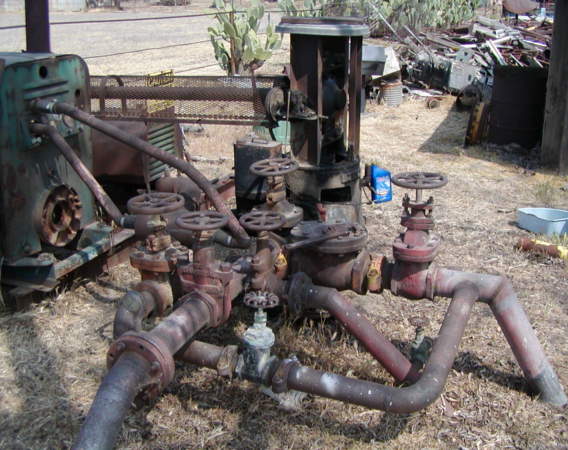
WATER VALVES TO EVERYWHERE.... I used to know where all the pipes went
to. We irrigated the 5 acres with this water well and most of the valves are for
irrigation distribution. The big red gate valve to the right goes to the boiler
water tank and it has a large check valve inline. All of this water system is
still in service.
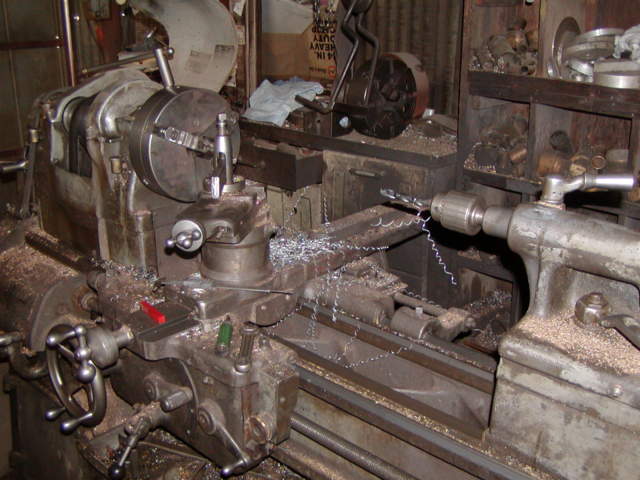
THE SOUTH BEND LATHE.... About the time I started to Bakersfield
High School, Pop bought this 16/24" by 20' bed South Bend lathe. It was a
16" lathe blocked up 4" so that it could handle 24" diameter work
pieces. Up until Pop got the lathe, we only had the little 10" Atlas lathe,
a toy compared to this machine. It was a boy's dream machine. Pop let me use it
and while I was going to high school, I took machine shop. Instead of making the
standard chisels and hammers that the class was making, the instructor let me
make tools for the South Bend. The first tool was the vertical 4" block for
the cross slide. The factory block was also offset back 6" and was very
awkward to use for turning anything under 12" in diameter. In the picture,
you can see the 4" vertical block under the cross slide. Note: The chuck
wrench is not in the chuck. It is in a holder behind the chuck that sits in one
of the socket head cap screws of the headstock bearing cap. There is more info
on the little 10" Atlas lathe on my Lathe
Biography on my Mini Lathe Page.
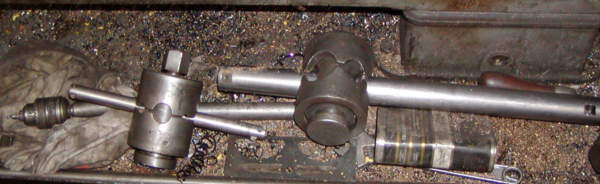
BORING BAR SET.... Another project for high school machine shop was a set
of 6 boring bars from 3/4" to 2" to fit the lathe. The large boring
bar, in the picture, is 1-1/2" diameter. I didn't see the 2" bar when
I took the picture. All of the bars were double ended. One end held the tool bit
at right angle to the bar and the other end held it at 45 degrees. The holes
were drilled and then filed square by hand. I remember spending quite a bit of
time with square files of various sizes. These tools are still in service after
some fifty or so years.
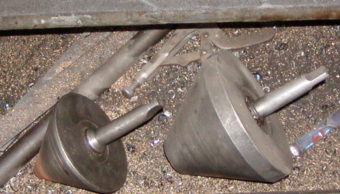
BALL BEARING PIPE CENTERS.... Pop needed a set of ball bearing pipe
centers so I made them for him at school. Tools in use might get dirty, but they
don't seem to gather rust.
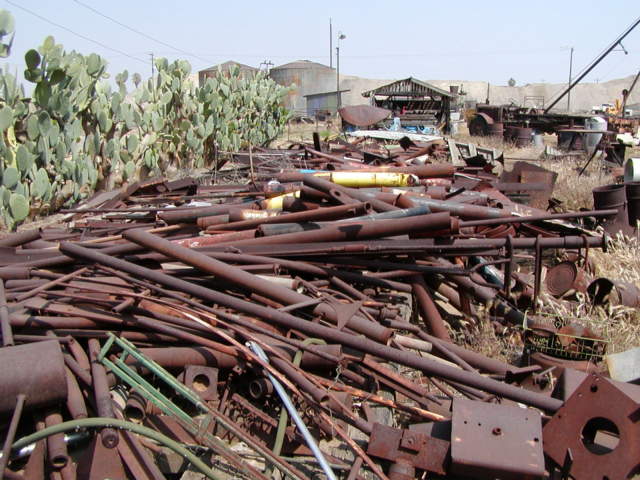
RAW MATERIAL SUPPLY SOURCE.... A welding and machine shop needs a lots of
raw material. In this pile one could find just about any chunk of steel to make
a new project. There are some very useful items hidden inside of those pieces of
metal waiting for an artist to release them. Junk collecting comes naturally to
me, I guess.
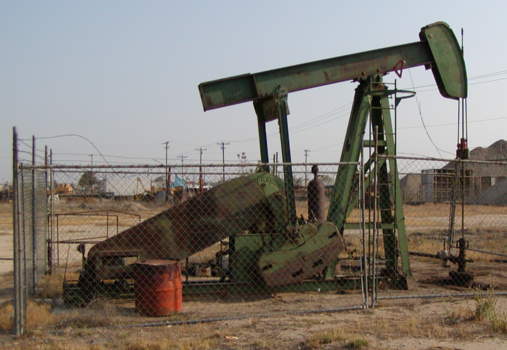
THE OIL WELL.... For many years the oil well had a big 100' tall wooden
derrick that I used to climb as a kid. Pop didn't discourage me, but told me to
always hold the side rails while climbing and never the rungs. One bad rung and
you are a goner. I used to climb up to the top with a pellet rifle and shoot
mice and lizards on the ground from up on top. It was strange because shooting
almost straight down, there was none of the usual drop. It was all drop. It
would take a few shots to see where the pellets were hitting.
STORY ABOUT THIS PUMPING UNIT.... Years ago, the police were transporting a convict from Taft to Bakersfield and when they were near Pop's place, they stopped for some reason. The convict overpowered the guard, kicked out the window of the police car and fled. It was the middle of the night and there were very few lights around. While running, the convict came to the fence around this pumping unit and jumped over it. He fell toward the counter balance weights, which were swinging on the down stroke, and his head was caught between the weight and the ground where there is only about 2 or 3" of clearance. It killed him outright and stalled the pump. The motor over heated and kicked out the circuit breaker and the pump maintenance man found it that way in the morning. I guess this pumping unit could be called Judge, Jury, and Sentence. Pop likes to tell the story. He worked hard all his life and doesn't think much of criminals or Democrats.
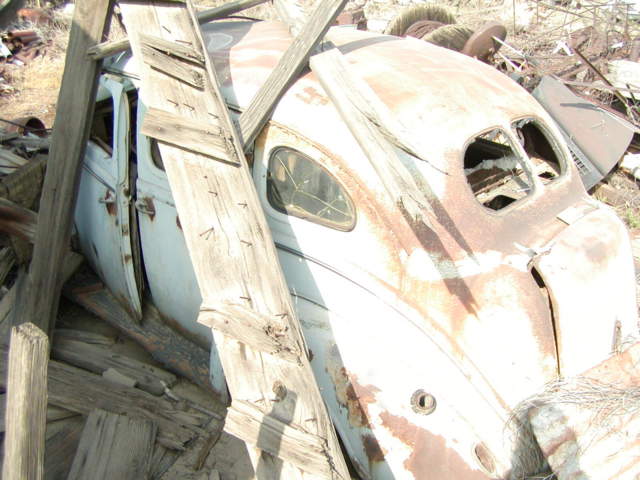
MY FIRST CAR.... I got to drive this 39 Plymouth Sedan when I was about
12 years old. No, I didn't get to drive in on the road, but there are a lot of
places to drive on 5 acres. I did get a drivers license when I was 16. This was
my pride and joy. Later in high school, I got to drive it to school. I
completely rebuilt the engine a couple of times. I bet the reader doesn't know
where his first car is located. It is still sitting there on the 5 acres. I
still had it when I started to college and went to Berkeley for my Freshman
year. It would do 40 mph without any problem, but any faster than that would
cause engine trouble. On the Christmas break, I was driving back to Bakersfield
from Berkeley and about Madera, on HW-99, I followed a guy for a long ways that
was doing about 39 mph. I got impatient and revved it up to about 45 mph and
passed him. It felt so good going that fast that I just left it there. About 5
miles of that and I burned out a connecting rod. I had to call Pop and he came
up to Madera with his welding truck and towed me all the way home in the middle
of the night. Pop wasn't happy about that. I spent the whole vacation time
rebuilding the engine. That was not what I had planned for.
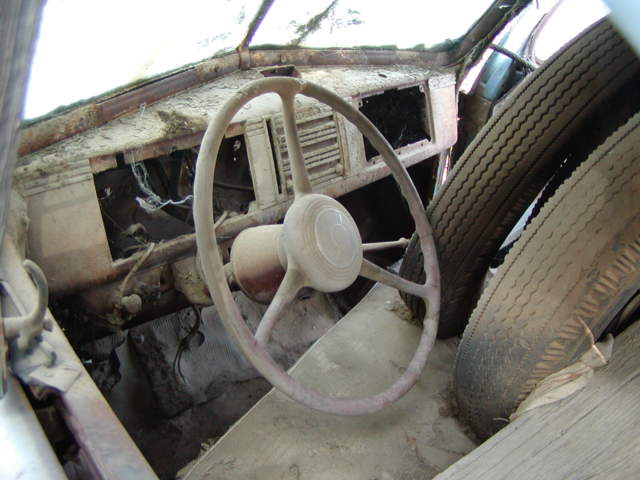
CONDITION NOT TOO GOOD.... The old Plymouth is not in too good a
condition these days. But it is still there. It sure was a dream car for a 16
year old in 1950.
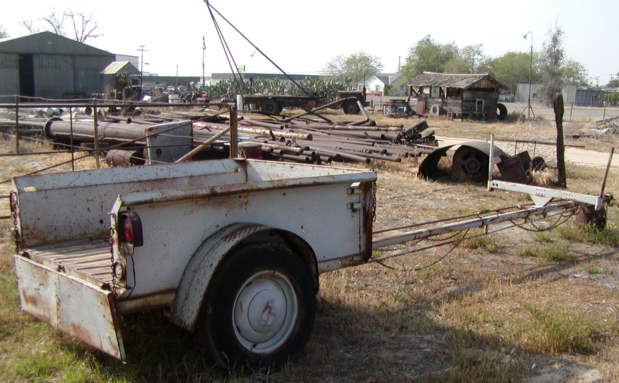
IDLE HANDS ARE THE DEVIL'S WORKSHOP.... Pop made a trailer out of an old
pickup bed. Before he got a sprinkler system and needed a long trailer to carry
the pipes, the trailer had a normal length tongue. This trailer and 4 acres of
Milo maize is why I got to drive the old Plymouth when I was 12 years old. Pop
bought a garden tractor and I plowed up the 4 acres with the garden tractor. It
was a poor design. The tractor had just enough power to pull the plow if I also
pushed. Once the field was plowed, a seeding attachment was used to plant Milo
maize corn. Four acres of it in neat rows. I irrigated it every week or so and
it grew fine and matured with full heads of corn. It dried out and all this time
I didn't know what was ahead. Then it was ready to harvest.
A POCKET KNIFE HARVESTER.... Pop had it planned all along, but he didn't tell me. I would get to drive the car and trailer and harvest the corn with a pocket knife. I could drive up the rows and stop every 10'. I would get out and cut off all the heads of corn and throw them in the trailer, then 10 more feet. When the trailer was full, I could drive all the way to the large storage tank and use a pitch fork and transfer the corn to the tank. Then I could drive all the way back to the field for another load. Do you know how many heads of Milo maize corn there are in 4 acres? Pop believed in keeping me busy and every summer there was always something new to keep a kid busy and out of trouble.
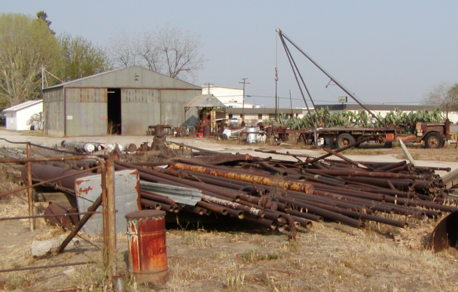
THE SHOP.... Pop built the welding and machine shop out of pipe and
sucker rod from the oil wells and covered it with tin. When he was building it,
he made each pipe joint air tight and connected the volumes. The shop structure
is also a 60 gallon compressed air tank with a quick connect air outlet at each
upright. Working with iron and steel, everything of any size was heavy. Pop got
the old "Mac" A-Frame truck from the old oil well worker, who had an
oil well across the street from us and put a De Soto engine in it. It still
runs, but the battery has to be charged before it will start.
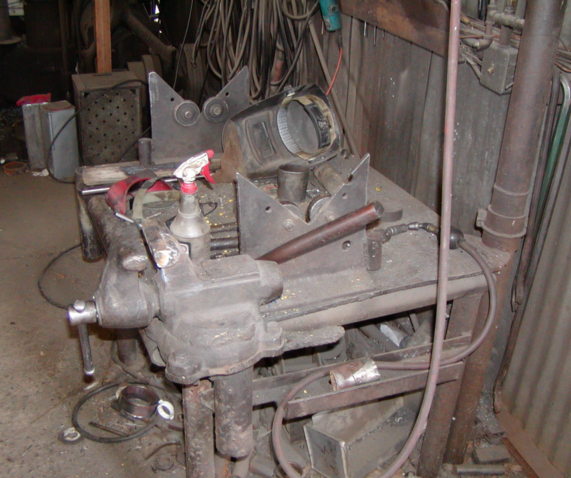
A LIFETIME OF HARD WORK HERE.... Here is Pop's welding bench. A lifetime
of fixing and creating was spent working here. Bill, my son, still runs the shop
and works jobs when they come in. Bill is just as creative as Pop. Notice the
compressed air connection just above the light switch at the right of the
picture. The frame for the whole shop is made of pipe and is the air pressure
tank for the shop.
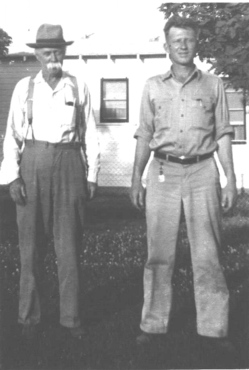 Alfred Harral Sr. Alfred Harral Jr. Grandpa and Pop about 1940 |
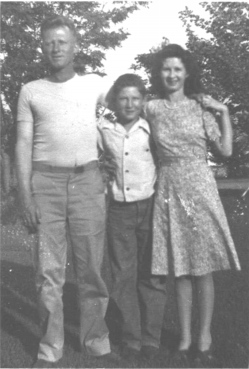 Pop, me and Mom about 1945 . |
IN HIS OWN WORDS.... I found a couple of cassette tapes made in 1977 of Pop talking about the early years and was able to convert parts of them over to the MP3 format. The quality is not very good, but the five sound clips sure are interesting to me. I am asking Pop questions and Mom and Mary Ann are talking in the background. You can click on the links to listen. Each clip is about 5 minutes long.
 pop-2yrs-age.mp3
(4.63MB) Pop was two years old when he moved to Bakersfield from New Jersey.
Grandpa came out first with $3000 to start an orange grove in 1910 and sent for
Grandma and Pop to follow after he had a place for them to stay. The early years
in the orange grove, the new trees froze and had to be cut back. Pop says that
it was minus 13 degrees F in 1913, but I think he meant 13 degrees F. Now days,
they would claim a cold snap like that was the start of a new Ice-Age, but in
those days, they just lived with it and continued on.
pop-2yrs-age.mp3
(4.63MB) Pop was two years old when he moved to Bakersfield from New Jersey.
Grandpa came out first with $3000 to start an orange grove in 1910 and sent for
Grandma and Pop to follow after he had a place for them to stay. The early years
in the orange grove, the new trees froze and had to be cut back. Pop says that
it was minus 13 degrees F in 1913, but I think he meant 13 degrees F. Now days,
they would claim a cold snap like that was the start of a new Ice-Age, but in
those days, they just lived with it and continued on.
pop-kern-river.mp3
(4.06MB) Around 1914, the Harral family would take a horse drawn wagon and go to
the mouth of the Kern River Canyon for camping and fishing trips. It was about
10 miles from the orange orchard and it took all day to get there. They didn't
have life preservers so Grandma tied Pop to a tree so he wouldn't drown. Of
course Pop fell in the river, but he used the rope to pull himself back out.
p-chicken-coup.mp3
(3.43MB) No silver spoon for the young Varmint Al! When I was about 2-1/2 years
old in 1936, we lived in a converted chicken coup. Pop tells about getting it
fixed up. Mom couldn't get along with Grandma and that is why we moved from the
ranch house to the chicken coup.
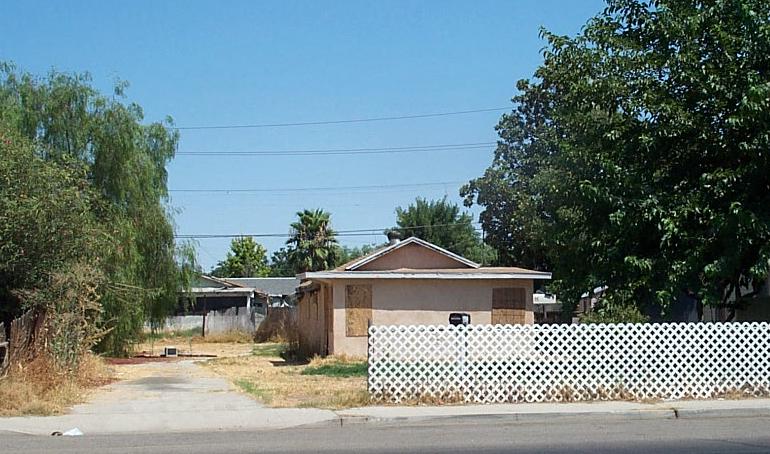
p-oildale-house.mp3
(5.19MB) The chicken coup wasn't far enough away from the mother-in-law so six
months later we moved to Oildale, CA. Pop moved a partially built house about 20
miles for $50. In 1937 the new lot at 708 Decatur St. in Oildale, CA cost $300
and Pop paid $25 down and $10/month for it. Pop built the house himself while we
lived in a small trailer house. There was quite a ritual to start the septic
tank working. I remember him going out and shooting a rabbit and throwing the
dead rabbit in the septic tank before he closed it up. The dead rabbit would
start the bugs working!
p-fruitvale.mp3
(1.85MB) In 1947 we moved to Fruitvale, CA. Pop paid $16,000 cash money for the
house on 5 acres. It was a perfect place to build a welding & machine shop.
The pictures on this page were taken on the 5 acre place. Pop got his first
welding truck for $350 which had been a garbage truck complete with odors.
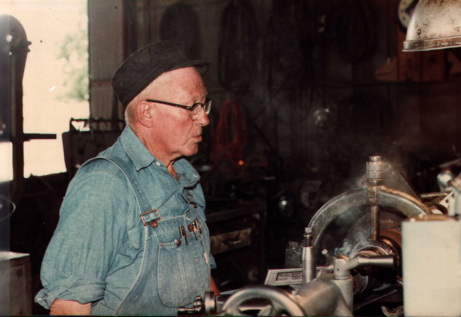
I sure am proud of Pop. He is a good and honest man. My whole childhood was one
big long father and son project.
Thank you, Pop.
Last Updated:09/13/2013
End of Page